Lists
Transaction Monitoring → Lists holds the managed lists your rules reference: country-risk sets, keyword packs, and counterparty block/allow lists. Rules reference a list by its key, so updating a list immediately updates every rule that uses it — no rule edits required.
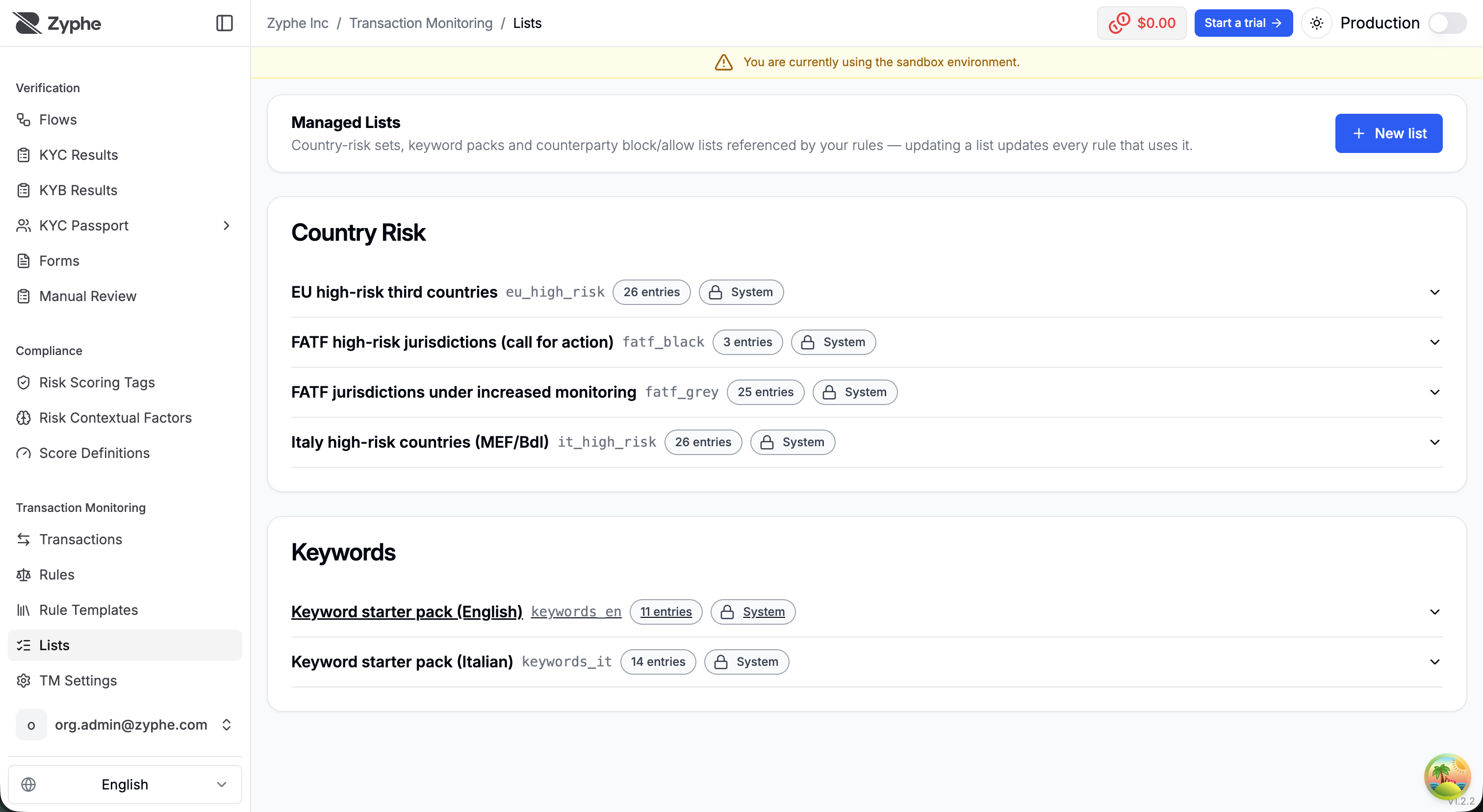
List kinds
| Counterparty Blocklist | Account identifiers (IBANs, wallet addresses) you never want to transact with |
| Counterparty Allowlist | Trusted counterparties — usable in rules to suppress noise on known-good flows |
| Country Risk | Sets of two-letter country codes grouped by risk (matched against origin and counterparty countries) |
| Keywords | Terms screened against the payment description (for example the SEPA causale) |
Each entry can carry an optional note with context for reviewers.
System lists and overrides
Zyphe ships system-curated lists (marked with a System badge) that you can reference from rules out of the box. Your organization's own lists extend them — and an org list created with the same key as a system list overrides it wherever rules reference that key. The system list is marked Overridden and its content stops matching until your override is deleted.
Deleting an org list means rules referencing its key stop matching its entries on the next evaluation.
How rules use lists
The rule builder exposes list matches as condition fields:
- Counterparty blocklist / allowlist hit — the transaction's counterparty account appears on a block or allow list.
- Country-risk hit — the origin or counterparty country appears in a country-risk list (any list, or a specific one by key).
- Keyword list hit — the payment description contains a term from a keyword list.
Rule templates often reference system lists by key, so instantiating a template works immediately — and you can sharpen it later by overriding the list with your own entries.